


Next: Conclusion
Up: Direct Numerical Simulation of
Previous: Boundary Conditions
DNS results have consistently shown excellent comparisons with experimental
data.
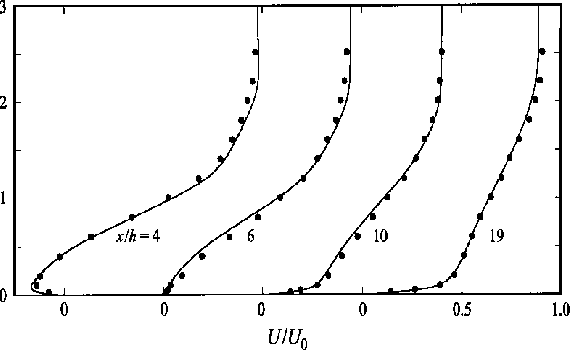
One of the comparisons of the results obtained by DNS of
turbulent flow over a backward-facing step (Le et al. [7])
with the experimental data obtained by by Jovic & Driver [5]
is shown in figure 1.
Figure:
Comparison of mean streamwise velocity profiles generated by
DNS of turbulent flow over a backward-facing step (Le et al. [7])
with experimental data obtained by Jovic & Driver [5]
 |
In 1987, Moin & Spalart [9] used DNS data from a turbulent
boundary layer to estimate the accuracy of cross-wire probes and to
quantify the magnitudes of the different sources of error.
DNS has recently been used to provide probe design criteria and
validate experimental measurements of vorticity in turbulent flows.
Kim et al. [6] performed DNS of the turbulent channel flow
(Rec=3300) using about 4 million grid points to resolve the
flow. Extensive comparison of the results to experimental data
was performed and in general, good agreement was found.
Anirudh Modi
4/30/1998