


Next: Boundary conditions and numerical
Up: High Order Accurate Solutions
Previous: Ship airwake simulation background
The methodology used here is based on the nonlinear disturbance equations,
which is a newly developed numerical method
[1]. From the general Navier-Stokes
equations in a Cartesian coordinate system:
|  |
(1) |
The flow field is then split into a mean and a
fluctuating part:
|  |
(2) |
where
|  |
(3) |
Substitution of equation (2) into (1) and rearranging
results in the nonlinear disturbance equations(NLDE):
|  |
(4) |
Where
|  |
(5) |
On the left hand side of the NLDE are terms related to the
perturbation properties and the cross terms,
whereas the right hand side has strictly mean flow terms.
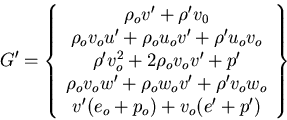
The perturbation terms contain linear and nonlinear quantities:
|  |
(6) |
|  |
(7) |
|  |
(8) |
and
|  |
(9) |
|  |
(10) |
|  |
(11) |
The mean flow source term Q is assumed to be time
independent:
|  |
(12) |
If the NLDE is averaged, it becomes
the Reynolds-averaged Navier-Stokes equation, where the Reynold's
stresses are on the left hand side.
Thus, for a laminar flow Q=0.
We seek a solution of the perturbation
variables  with a known mean flow field which can be obtained from
existing
well-developed CFD codes (e.g. CFL3D, INS3D, OVERFLOW, ...)
for steady flow. The CFD code for mean flow is a lower order method that is
ineffective for unsteady flow due to their inherent dissipation and
dispersion. The NLDE method is a higher order accurate method that requires
much fewer grid points than a lower order method. This methodology allows us to use the most
effective algorithms for the steady and unsteady
portions of field, respectively. NLDE combined with characteristic type boundary conditions makes introducing various wind conditions straight-forward.
It also minimizes
round-off error since we are only computing perturbations. More discussion on
this new method is in [1].
with a known mean flow field which can be obtained from
existing
well-developed CFD codes (e.g. CFL3D, INS3D, OVERFLOW, ...)
for steady flow. The CFD code for mean flow is a lower order method that is
ineffective for unsteady flow due to their inherent dissipation and
dispersion. The NLDE method is a higher order accurate method that requires
much fewer grid points than a lower order method. This methodology allows us to use the most
effective algorithms for the steady and unsteady
portions of field, respectively. NLDE combined with characteristic type boundary conditions makes introducing various wind conditions straight-forward.
It also minimizes
round-off error since we are only computing perturbations. More discussion on
this new method is in [1].
Next: Boundary conditions and numerical
Up: High Order Accurate Solutions
Previous: Ship airwake simulation background
Anirudh Modi
2/26/1998