Analysis of this unexpected behavior has, over the years, attracted the attention of a number of very famous scientists, ranging from William Thomson in the late 19th century to Niels Bohr and Wolfgang Pauli in this century. Indeed, there is a wonderful photograph in the American Institute of Physics's Niels Bohr Library of Pauli and Bohr watching an inverting Tippe top. The first accurate modern explanations of the top's behavior date from the 1950s, when they were put forward independently by Braams, Hughenholz and Pliskin. But possibly the most rigorous analysis of the top's mechanics is that by the American physicist Richard Cohen at the Massachusetts Institute of Technology in 1977. He also developed computer-generated solutions of the equations of motion.
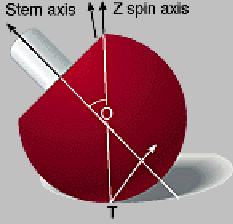
The behavior of the Tippe top can be described for the non-mathematician in fairly simple terms by looking at the earlier figure. When the top is set spinning the low center of mass causes the center to be centrifugally displaced from the spin axis (Z), which remains perpendicular to the surface on which the top is spinning. The angular momentum component along Z remains dominant before and after inversion, although in respect of the solid-body coordinates of the top, the direction of rotation has been reversed. During the inversion the center of mass of the top is raised and its rotational kinetic energy is reduced, providing the potential energy to raise the center of mass. Thus the total angular velocity and the total angular momentum are reduced during the inversion process. This process requires the action of a torque, but this torque cannot be provided by gravity or the normal forces exerted at the point of contact with the surface (T). The explanation lies in the presence of sliding frictional forces between the round bottom of the top and the surface on which it is spinning. These forces arise through the centrifugal displacement of the center of mass when the top is set spinning. If the initial spin velocity imparted to the top when it is set in motion is sufficiently high, nutation and oscillations of the Tippe top's motion eventually result in the edge of the stem making contact with the surface and the top then rising to the inverted position. This behavior of raising the center of mass also occurs in a normal whip-top. It is not normally appreciated that this occurs because the whip-top does not perform the spectacular inversion that is so obvious in the case of the Tippe top. It merely rises up from lying on its side into the vertical position.