


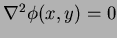
 is reasonably complex and depends on the
specified boundary conditions.
For simplicity, the boundary conditions in our numerical experiment are
specified only on the ``edges'' and are set to be zero, so that the
expected solution of the problem is trivial (zero everywhere), thus
making the comparison easy. Two versions of the relaxation algorithm are
implemented, one using the average of only the ``old'' values of the
neighbors (version 1):
is reasonably complex and depends on the
specified boundary conditions.
For simplicity, the boundary conditions in our numerical experiment are
specified only on the ``edges'' and are set to be zero, so that the
expected solution of the problem is trivial (zero everywhere), thus
making the comparison easy. Two versions of the relaxation algorithm are
implemented, one using the average of only the ``old'' values of the
neighbors (version 1):

