


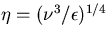
 , is commonly quoted as the smallest
scale that needs to be resolved. However, this requirement seems to
be too stringent, and it is observed that the smallest resolved length scale
is required to be of
, is commonly quoted as the smallest
scale that needs to be resolved. However, this requirement seems to
be too stringent, and it is observed that the smallest resolved length scale
is required to be of  and not equal to
  . Spectral DNS
shows very good agreement with experiments even though the Kolmogorov
scale is not resolved. The smallest length scale that must be accurately
resolved depends on the energy spectrum, and is typically greater than
the Kolmogorov length scale; e.g. Moser & Moin [6] noted
that most of the dissipation in the curved channel occurs at scales
greater than
. Spectral DNS
shows very good agreement with experiments even though the Kolmogorov
scale is not resolved. The smallest length scale that must be accurately
resolved depends on the energy spectrum, and is typically greater than
the Kolmogorov length scale; e.g. Moser & Moin [6] noted
that most of the dissipation in the curved channel occurs at scales
greater than  (based on average dissipation).
The resolution requirements are also fairly influenced by the numerical method used. Differencing schemes with larger numerical error would require higher resolution to achieve the same degree of accuracy compared to the spectral methods and the other more accurate finite differencing counterparts. Other factors which influence the spatial resolution are the differentiation error and the errors associated with the nonlinearity of the governing equations (triadic interaction between the scales, and aliasing), which should be sufficiently small.
And then of course, the Reynolds number plays the most important role. An acknowledged limitation of DNS is its restriction (by cost considerations) to low Reynolds number. For channel flow, the approximate number of grid points needed can be estimated from the expression by Wilcox [17]

 is the Reynolds number based on the mean channel velocity
and channel height. According to the above expression, to compute a
flow with Reynolds number of 106 which we encounter in real-life,
we would require approximately 133 billion grid points which
is astronomical. To reduce this cost somewhat, Reynolds number scaling
is used whenever possible depending on the observed dependence of the
flow on the Reynolds number without changing the essential physics.
Thus the choice of optimum Reynolds number for DNS is dependent on
the application, as DNS need not obtain real-life Reynolds numbers
to be useful in the study of real-life applications.
is the Reynolds number based on the mean channel velocity
and channel height. According to the above expression, to compute a
flow with Reynolds number of 106 which we encounter in real-life,
we would require approximately 133 billion grid points which
is astronomical. To reduce this cost somewhat, Reynolds number scaling
is used whenever possible depending on the observed dependence of the
flow on the Reynolds number without changing the essential physics.
Thus the choice of optimum Reynolds number for DNS is dependent on
the application, as DNS need not obtain real-life Reynolds numbers
to be useful in the study of real-life applications.