


Next: Finite Difference vs. Spectral
Up: Numerical Issues
Previous: Numerical Issues
The major problem with any numerical solution of a differential
equation is accurate calculations of derivatives. This is why
nearly all early turbulence DNS's utilized spectral methods, which are
extremely accurate and non-dissipative tools for calculating
derivatives of discrete data sets.
If crafted correctly, such methods enjoy exponential convergence
to a highly accurate solution. A spectral method actually approximates
a real-space function with a series sum of orthogonal functions.
Mathematically, this looks like:
|  |
(1) |
The most common choice for the orthogonal functions is the Fourier
series. This may seem to complicating things, but actually this helps
to calculate the spatial derivative of f since Fourier series
functions (complex exponentials) are easy to differentiate. Again,
mathematically this results in:
|  |
(2) |
which are the inverse Fourier transformation and the Fourier
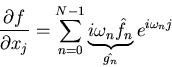
transformation, respectively. Now, we can differentiate f :
|  |
(3) |
Therefore, in order to calculate the derivative of f,
(1) calculate the Fourier transform,
(2) compute new Fourier coefficients, and
(3) calculate the inverse Fourier transform of the new series (with
calculated coefficients from (2)).
This method is quite time consuming, but with the help of the Fast
Fourier Transforms (FFT), the method becomes  instead of
O(N2). However, several important stipulations must be observed
when using this method to solve the Navier-Stokes equation:
instead of
O(N2). However, several important stipulations must be observed
when using this method to solve the Navier-Stokes equation:
- 1.
- The orthogonal functions should be well behaved and continuous
to reduce Gibb's phenomena as much as possible (i.e. to recover pointwise
exponential accuracy at all points including the discontinuities).
- 2.
- Grid spacing must be on the order of the Kolmogorov scale
of the flow (smallest scale within the flow).
- 3.
- Aliasing errors (false translation of new modes into the
domain) due to convective terms should be removed. They can cause either
numerical instability or excessive turbulence decay.
One of the big disadvantages of this method is that it is not yet clear
how these procedures can be extended to curvilinear grids which is
so common in aerodynamics.
Next: Finite Difference vs. Spectral
Up: Numerical Issues
Previous: Numerical Issues
Anirudh Modi
4/30/1998